Envoy-Gateway
There’s different ways to use Gateway API in a multi-tenant setup. This guide suggested a strong isolated implementation using the Envoy Gateway Project. The Architecture suggested looks something like this:
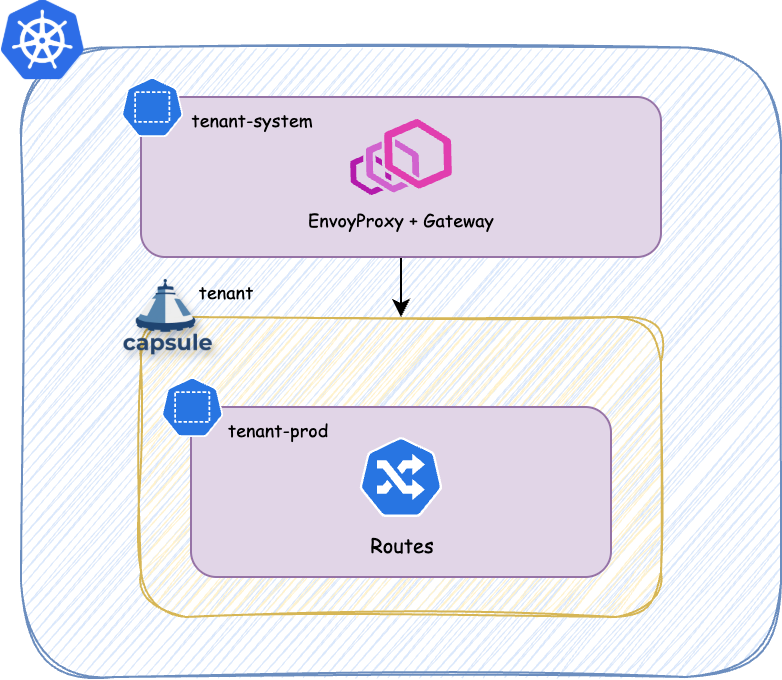
Each tenant will get it’s own -system Namespace. However that namespace is not managed by the Tenant nor part of it. It’s the namespace where the platform deploys managed services for each Tenant, which are out of bound for TenantOwners.
Example
Implementation of the above architecture looks something like this.
Managed Gateway
With this GlobalTenantResource we generate the managed gateway for each tenant. The EnvoyProxy is the custom resource used by the Envoy Gateway project to manage the lifecycle of the Envoy instances. The Gateway is the standard resource defined by the Gateway API, which references the EnvoyProxy as infrastructure and defines the listeners and allowed routes.
---
apiVersion: capsule.clastix.io/v1beta2
kind: GlobalTenantResource
metadata:
  name: managed-envoy-gateway
spec:
  scope: Tenant
  resyncPeriod: 30s
  resources:
    - context:
        resources:
          - apiVersion: gateway.networking.k8s.io/v1
            kind: HTTPRoute
            index: https
            selector:
              matchLabels:
                projectcapsule.dev/tenant: "{{tenant.name}}"
      generators:
        - missingKey: zero
          template: |
            {{- $ingressBandwidth := dig "spec" "data" "networking" "ingress" "bandwidth" "" $.tenant }}
            {{- $egressBandwidth := dig "spec" "data" "networking" "egress" "bandwidth" "" $.tenant }}
            {{- $loadBalancerIP := dig "spec" "data" "networking" "ingress" "loadbalancer" "" $.tenant }}
            ---
            apiVersion: gateway.envoyproxy.io/v1alpha1
            kind: EnvoyProxy
            metadata:
              name: tenant-{{ $.tenant.metadata.name }}-gateway
              namespace: tenant-{{ $.tenant.metadata.name }}-system
            spec:
              logging:
                level:
                  default: info
              provider:
                type: Kubernetes
                kubernetes:
                  envoyDeployment:
                    replicas: 2
                    pod:
                      priorityClassName: tenant-critical
                      {{- if or $ingressBandwidth $egressBandwidth }}
                      annotations:
                        {{- with $ingressBandwidth }}
                        kubernetes.io/ingress-bandwidth: {{ . }}
                        {{- end }}
                        {{- with $egressBandwidth }}
                        kubernetes.io/egress-bandwidth: {{ . }}
                        {{- end }}
                      {{- end }}
                  {{- with $loadBalancerIP }}
                  envoyService:
                    loadBalancerIP: {{ . }}
                  {{- end }}

        - missingKey: zero
          template: |
            ---
            apiVersion: gateway.networking.k8s.io/v1
            kind: Gateway
            metadata:
              name: tenant-{{ $.tenant.metadata.name }}-gateway
              namespace: tenant-{{ $.tenant.metadata.name }}-system
              annotations:
                cert-manager.io/cluster-issuer: managed-cluster-issuer
                cert-manager.io/private-key-size: "4096"
                cert-manager.io/private-key-algorithm: RSA
            spec:
              gatewayClassName: tenants
              infrastructure:
                parametersRef:
                  group: gateway.envoyproxy.io
                  kind: EnvoyProxy
                  name: tenant-{{ $.tenant.metadata.name }}-gateway
              listeners:
                - name: http-challenge
                  port: 80
                  protocol: HTTP
                  allowedRoutes:
                    namespaces:
                      from: Selector
                      selector:
                        matchLabels:
                          capsule.clastix.io/tenant: "{{ $.tenant.metadata.name }}"
                {{- range $_, $http := $.https }}
                  {{- range $i, $hostname := $http.spec.hostnames }}
                - name: {{ $http.metadata.namespace }}-{{ $http.metadata.name }}-{{ $i }}
                  port: 443
                  protocol: HTTPS
                  hostname: {{ $hostname}}
                  tls:
                    mode: Terminate
                    certificateRefs:
                      - group: ''
                        kind: Secret
                        name: {{ $http.metadata.namespace }}-{{ $http.metadata.name }}-{{ $i }}-tls
                  allowedRoutes:
                    namespaces:
                      from: Selector
                      selector:
                        matchLabels:
                           kubernetes.io/metadata.name: "{{ $http.metadata.namespace }}"
                  {{- end }}
                {{- end }}
Certificate Management
If we additionally would like to do Certificate Management via cert-manager in combination with ACME HTTP-01 challenges we probably want to provide the users with a ClusterIssuer per Tenant:
apiVersion: capsule.clastix.io/v1beta2
kind: GlobalTenantResource
metadata:
  name: tenant-acme-issuer
spec:
  scope: Tenant
  resources:
    - rawItems:
      - apiVersion: cert-manager.io/v1
        kind: Issuer
        metadata:
          name: {{tenant.name}}-acme-http
          namespace: {{tenant.name}}-system
        spec:
          acme:
            email: platform@email.com
            server: https://acme-staging-v02.api.letsencrypt.org/directory
            privateKeySecretRef:
              name: cert-letsencrypt-staging
            solvers:
              - http01:
                  gatewayHTTPRoute:
                    parentRefs:
                      - group: gateway.networking.k8s.io
                        kind: Gateway
                        name: {{tenant.name}}-gateway
                        namespace: {{tenant.name}}-system
                        sectionName: http-challenge